School has been in session for one week today. This time last year I was in a daze, a fog of insensibility brought on by the overwhelming realization that I don't know anything! It's one thing to go to school and earn a degree, but try teaching children - of any age - something...anything. Maybe it's just me, but the more I teach, the more I have to come to terms with my own ignorance. It's quite humbling, actually.
But today was a little different. Today I actually taught my algebra 1 students something: scientific calculators do fractions. I had taken for granted that they knew how to use their calculators. "I wish we could do fractions on this thing," one girl said. "You can," I said, half thinking she was making a very weird joke. I guess I thought people were born knowing how to use a calculator.
I know it's just a little thing, but the light bulbs that went on for those kids when they realized how to enter "five-ninths" into their calculators without having to make it a decimal was oddly rewarding for me. "This thing was SO worth six bucks!" according to one boy. Yes, that was my triumph of the day. Now if only I could get that to happen with an actual lesson...
Showing posts with label education. Show all posts
Showing posts with label education. Show all posts
Thursday, August 27, 2009

Friday, July 31, 2009
Latin is Cool
Did you know that the Latin word "liber" means both "free" and "book"? They are pronounced slightly differently ("lih-bear" for book; "lee-bear" for free). Despite the pronunciation difference, I can't get past the idea that the identical spelling is no coincidence.
In ancient times, free men were educated men. They received a classical, or "liberal" education. Being educated meant, among other things, that you could read a book. There is a freedom, a liber-ty, in being able to pick up a book and learn.
Today I hear about people reading in order to escape troubled circumstances in life. Libraries (see the "liber" there?) invite children to step into new worlds through reading. Poor, underprivileged students can "hit the books," work hard, and better their lives. These are all types of freedom.
In order to maintain freedom, a people must not neglect education. Books are portals to new realms, and education unlocks the doors. If children don't learn to read, they will inevitably be uneducated as adults, burdened with quite a handicap. But what about kids who learn to read, but don't learn to love to read? It's disturbing when people admit they never take time to read books. Freedom is linked to education.
Consider, also, the 1,000+ pages long bills rushed through the legislature which many members of Congress don't read entirely before voting on. The bills aren't read, and our freedom is chipped away.
The Romans were no dummies. The Latin words for "free" and "book" are intimately related, and we should take note of that today. Turn off the TV for a while, and pick up a book.
Wednesday, July 15, 2009
Mummy Madness
Last year I got this crazy idea to incorporate a really hands-on project with my 13 first and second graders during a unit on Egyptian mummies. It was several months into school, so I had already learned from previous, less involved art projects that you can never be overprepared. I resolved to complete a sample project myself, have all the materials ready, and even write out my own list of step-by-step instructions so the whole thing would go smoothly in the classroom.


Yeah, right.
The project: Making a cat mummy inspired by the real thing.
(real thing)
Procedure: I found a book at the library with instructions on making a cat mummy using old socks stuffed and tied, strips of fabric from old t-shirts, and tea bags. My mom got in on the fun, too. She helped cut and dye the fabric, partially stuff the socks, and draw little faces on the poor departed felines.
We ran into our first problem at home. Most people would have torn the fabric, dyed it in tea, dried it in the dryer, then tied the strips together for bandages. We do things differently in the Ozarks. My mom and I tore the fabric, tied the bandages into roughly 10-ft-long strips, dyed them in the sink, and then brilliantly threw the whole gigantic, enormously confused heap into the dryer. And oh, the monster that emerged. It took the two of us an hour to navigate through that maze. We might have been hallucinating by the end of it.
Perhaps I should've taken that as a sign and dropped the whole silly project. But nooo. I just had to keep going.
The plan was to have the mummy heads prepared so the students could stuff the bodies, tie the ends with my help, and then wrap the bandages. Simple enough. I was prepared. Nothing would catch me off-guard.
When the time rolled around, I explained to the children what they would be doing and they could hardly contain their excitement. Their very own cat mummy! To take home and show Mom and Dad! COOL! So I triumphantly unveiled the example I had prepared:
(cute, huh?)
The sight was met by a satisfying mix of oohs and aahs, until one little girl said, "It looks like the baby Jesus wrapped in swaddling clothes!" How do you keep from laughing at something like that?
When I pulled out their mummies, it was apparent that the body was made from socks. "Stinky" socks, they thought, since the tea had made them so dingy. I passed one out to each student, instructing them to leave the socks on their desks until everyone had one. Here was an interesting display of the difference between girls and boys. All the girls picked up their partially-completed mummies and began rocking them in their arms, cooing at their imaginary babies. The boys turned theirs into weapons. If they weren't bludgeoning each other with stuffed cat heads they had them turned upside down to use as punching bags. Different, yes, but alike in that none of them left the sock on their desk as they were told!
Once I regained control of the room, I passed out old newspapers for the kids to tear up and begin stuffing. Boy, did they love that. I was trying to do damage control as paper went flying when I noticed one first grade girl sitting quietly with her paper opened, trying to read one of the articles, oblivious to the mayhem surrounding her. It was the oddest thing to discourage her from reading and tell her to be destructive instead.
Finally, the bodies were stuffed, the feet were tied, and it was time to pass out the bandages. It seemed straightforward enough with a neat little bag for each student. I think some kids might ahve been trying to mummify themselves instead of their cats.
The wrapping was tricky, though not much more than I had anticipated. Thankfully I had a parent volunteer to help with finishing up the project. But it was still chaos. I had the students sing through their review songs just to control the noise level as we adults walked around to help as needed.
At last, we were finished. All the trash was thrown away, and sitting atop each student desk was a quirky, one-of-a-kind, homemade cat mummy. I orally quizzed them about the why and how of Egyptian mummies to reinforce why we did that project. Yes, their minds were on ancient Egypt. My efforts were a success, of sorts.
As the students packed up, one second grade boy showed me how the bandages were coming loose over his mummy's face. "Mrs. Smith," he said excitedly, "mine's a wounded Civil War soldier!" Then he made his mummy/soldier hobble around on his desk, groaning from the pain of his battle scars.
Did I say ancient Egypt...?
Monday, July 13, 2009
Finding the Trinity in Music
I was introduced to this fascinating illustration of Jeremy Begbie's while listening to a presentation by the very gifted Mr. John Hodges. Let's see if I can do it justice:
We are visual creatures. We understand things visually. This, in part, makes the Trinity - one God, three Persons - so difficult for us to comprehend. How can two or more things occupy the same space without losing their distinction? It's basic physics!
Most of us have seen the baseball diamond-looking picture that is meant to help us with this concept.
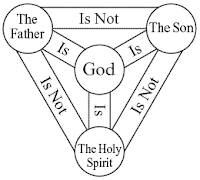
We may be able to articulate the idea of the Trinity, but the imagery is still problematic for us.
This is where Begbie has a wonderful insight. He suggests that music can benefit theology by better illustrating audibly what is so limiting visually. We're talking more than appropriately matching words to music, though that is certainly of great importance.
Take the doctrine of the Trinity, for example. The most basic chord is called a triad, and it is made up of 3 notes (tri - triad - Trinity...just checkin'!). Take away one note, and it is no longer a triad. To play the chord, all three notes must be played at once. It is one chord, but it is made up of 3 distinct notes. You don't hear one note, and then another, and then another. This wouldn't be a chord, but an arpeggio, or broken chord. You don't percieve one note in the chord to the exclusion of the other two, either. Three equal notes, one triad.
In Begbie's own words from Beholding the Glory:
"What could be more apt than to speak of the Trinity as a three-note-resonance of life, mutually indwelling, without mutual exclusion and yet without merger, each occupying the same ‘space,’ yet recognizably and irreducibly distinct, mutually enhancing and establishing each other? To speak of three strings mutually resonating instantly introduces a dynamism ... far truer to the trinitarian, living God of the New Testament.”
So simple, yet so amazing, isn't it?
Wednesday, July 8, 2009
Thoughts on Christian Education
***WARNING: RIDICULOUSLY LONG POST AHEAD***
Lately I have been wrestling with the implications of certain Christian theologies for education. I consider myself a staunch orthodox Lutheran, but I work at a non-denominational classical Christian school with heavy Reformed influence. I commend their commitment to Christian education (reflections on the "classical" aspect are for another post). But I question their line of argumentation it in favor of pulling kids out of public schools and sending them to private Christian schools or homeschooling.
They begin with the premise that Christian parents have an obligation to provide their children with a Christian upbringing, which would include a Christian education. Agreed. Not many Christians would argue with that one.
Next they point out the anti-Christian nature of the public school system (conceding that there are, in fact, committed Christian teachers in the public school setting) as well as its declining academic quality. Ok, no problem there.
Christians therefore need viable, academically rigorous alternatives for their children. Indeed!
The next step is often to point out how Christian children who receive a Christian education will grow into adults who influence the world by "taking dominion" of creation. Now I'm starting to get uncomfortable, but I'm still listening.
They say Christians are to "transform the world through the power of the Spirit."* This seems to stand in opposition to the Lutheran understanding of the two realms, the same understanding which some Reformed actually "blame for the rapid secularization of the West."* I am now on the alert for a path of escape.
Finally, some Christian education proponents argue, "if Christians remain faithful in influencing their world with the gospel, actions of the ungodly will be eliminated."* What?! No more sin? Does this mean Christian education will lead to Heaven on earth? As appealing as that sounds, I need to find the exit! (And no, the eschatalogical influence here has not escaped me.)
*Note: I'm leaving the sources for these quotes unnamed, but I will provide them privately upon request.
Analysis:
I realize that not all Reformed follow this admittedly simplified line of reasoning. I also know that not all who argue in this fashion would label themselves as Reformed or be accepted by others who call themselves such. My point is that the argument taken as a whole would likely not be adopted by an orthodox Lutheran, at least, not this orthodox Lutheran. We have therefore moved beyond "mere Christianity" into terrain that divides Christians. If we are divided, then the secularists have won.
It has been hard for me to put my finger on the fundamental differences. I'll point out the one difference that has become clearer for me in the last few days. Using H. Richard Niebuhr's categories, I think that a "Christ transforming culture" approach and a "Christ and culture in paradox" approach will often look very different when it comes to the why and how of Christian education. Yes, the Christian is transformed, we might say regenerated, in Christ. What's missing is the acknowledgement that the Old Man still exists even within the most devout believer. Simil iustus et peccatur. Simultaneously saint (justified) and sinner. The tension between these two natures is the paradox Lutherans point out. The Old Man must daily be drowned and die, but he is with us until we are with Christ.
So what's the big deal? It's not as if the Reformed are saying we are no longer sinful once we come to faith. But I think it is a big deal. I think the Gospel is at stake. Focusing all our energies on transforming the culture with the expectation that we will, invariably, see the good fruit of our labor takes our eyes off of the cross and our desperate need for forgiveness. "But of course we still need forgiveness," a Reformed educator may say. At least, that is what my headmaster will say. And yet he would not hesitate to admit that the knowledge of Christ crucified for our sins is typically taken as a given, that the Christian already knows he is forgiven for Christ's sake, so let's get on with our sanctification...
...and that is precisely the problem. I work in a Reformed setting, I have been to two national conferences for Reformed Christian education, I have read many education books by Reformed authors, and I still have to whip out the geiger counter for a trace of the Gospel. "You are forgiven," I tell my students. "Jesus died on the cross FOR YOU!" They know it, but they still need to hear it. I know my husband loves me, but I still need to hear it. Constantly.
I believe in Christian education. I support efforts to persuade parents to take their children out of the public schools and offer them something better. I think Christian academics have a shining legacy in the history of western civilization. But I know that Christian schools are staffed by sinners, and attended by sinners. I do not harbor any illusion that these noble efforts in a broken world will result in anything other than a world that is still broken. And yet, we are forgiven in Christ. In that forgiveness, we can move forward, free to continue in our imperfect efforts, with the sure knowledge that Christ has already conquered.
Subscribe to:
Posts (Atom)